Breeder (Hyperion) Control-Room View
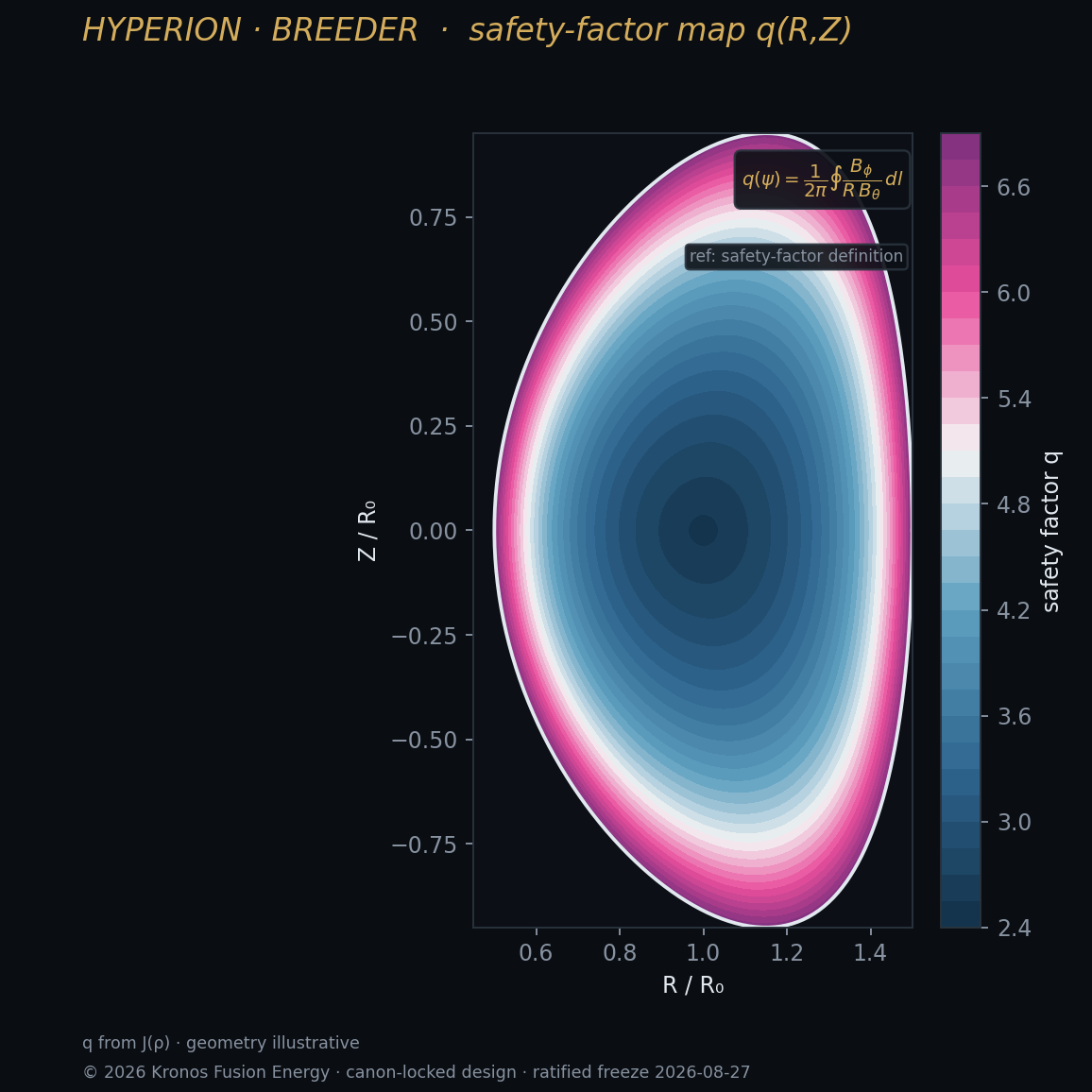
The operator surface tuned to the spherical tokamak's hard problems: equilibrium reconstruction, the ELM-free negative-triangularity shape, and disruption avoidance.
What the breeder operator watches
The breeder (Hyperion) is a D-T spherical tokamak with Q_sci 3.076, 85.0 MW fusion power, 9.66 MA plasma current, and 16.84 T peak field. Its control-room view foregrounds the three problems that dominate its operation: holding equilibrium, maintaining the ELM-free negative-triangularity boundary at delta -0.30, and avoiding disruptions. The 3D overlay centers the spherical-torus flux surfaces; the console strips carry current, shape, and stability margins.
Equilibrium and shape
The reconstructed equilibrium is drawn live on the vessel geometry, with the last-closed flux surface highlighted and its measured triangularity displayed numerically beside the target -0.30 — so shape drift is read as a number, not inferred from a picture. PF-coil currents and their headroom are shown as the actuators that hold the shape. Vertical and radial position errors are drawn against their stability limits, since vertical stability is a fast, safety-relevant loop.
- LCFS with measured vs target triangularity (-0.30) and ELM-free status
- Plasma current vs 9.66 MA reference, with ramp phase
- Vertical/radial position error against stability envelope
- PF/CS coil currents and remaining headroom
- Q_sci trajectory vs 3.076 and fusion power vs 85.0 MW, with confidence
Disruption avoidance front and center
The disruption-risk index from the anomaly ensembles and its lead time are permanently visible, not buried. As risk rises, the view escalates: the predictive shadow's forecast trajectory is emphasized, the driving precursors are named, and the operator is offered the mitigation path. If avoidance fails, the view hands off cleanly to the disruption countdown. Magnet health (REBCO strain, quench margin at 16.84 T) sits alongside, since a magnet fault and a plasma fault can co-occur.
Tritium-cycle context — the breeding ratio lever (1.1 / 1.5 / 1.8) and fuel balance — is present but secondary to real-time stability. Contrast this surface with the burner's in the burner control view, and see how forecasts are shown in predictive shadow visualization.