Disruption Precursors in the Breeder
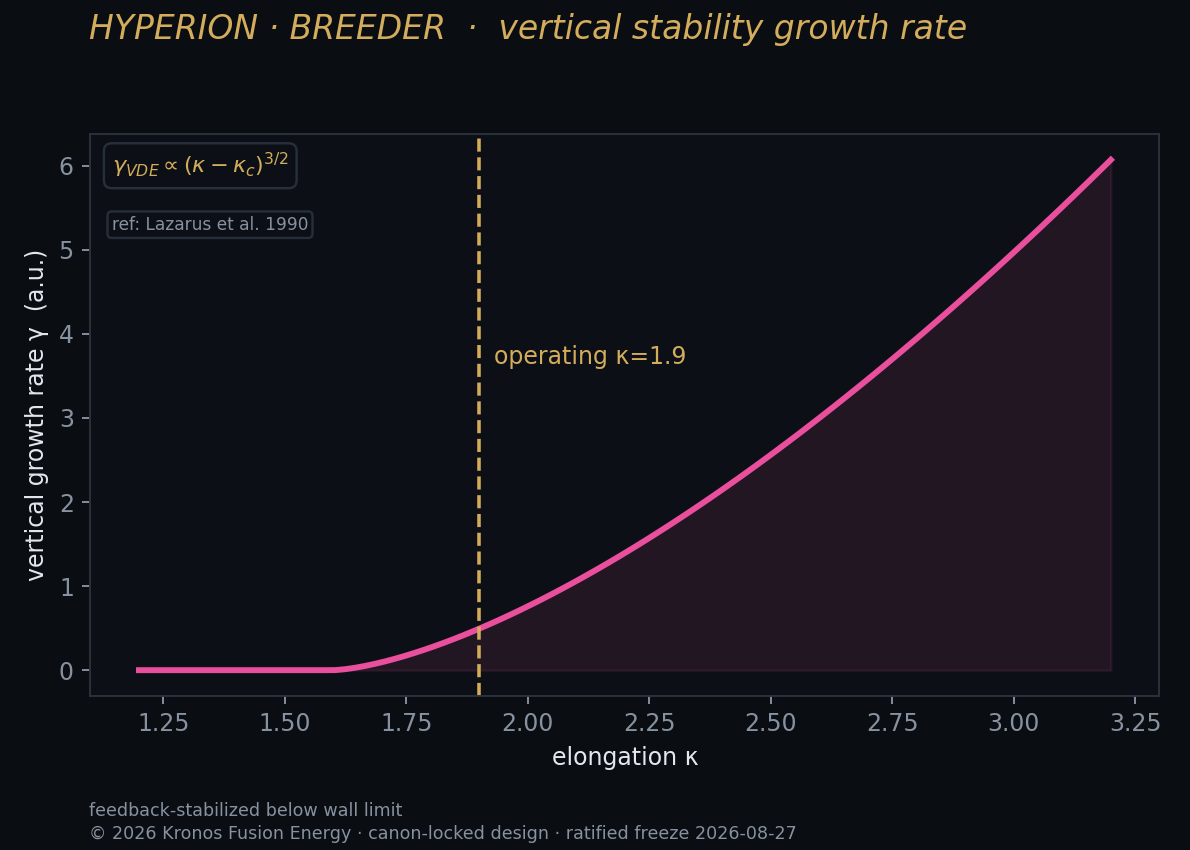
For Hyperion, the anomaly ensemble specializes in the magnetic and kinetic signatures that precede a tokamak disruption, feeding disruption avoidance.
Why disruptions are the breeder's defining risk
A disruption is a sudden loss of the tokamak plasma's confinement and current, dumping thermal and magnetic energy into the vessel. In a high-current spherical tokamak (9.66 MA) this is the event control most wants to avoid. Disruptions are usually preceded by identifiable precursors, and catching them early is the difference between a planned soft landing and an uncontrolled event.
- Locked modes: a rotating tearing mode slows and locks to the wall (Mirnov phase)
- Density-limit approach: radiation and edge cooling signatures
- Vertical-stability erosion: the elongated plasma drifts toward a VDE
- MHD-limit approach: growth-rate margin from the stability PINN shrinking
How the ensemble reads them
The Mirnov/flux-loop subgraph GNN identifies mode number, amplitude and rotation; a slowing rotation with growing amplitude is the classic locked-mode precursor. The stability PINN supplies a continuous margin to the ideal-MHD and peeling-ballooning boundaries. The forecast-residual detector flags when the plasma stops following the twin's projection. Combined, these give a disruption probability with a dominant-mechanism label, which tells the avoidance controller what to do.
Avoidance is mechanism-specific: a locked mode may be addressed by shape and current adjustment, a density-limit approach by fueling reduction, a vertical instability by the vertical-position controller. These are pre-computed MPC maneuvers triggered on the ensemble's labeled precursor, because disruption lead times are short.
When avoidance is not achievable in the time available, the twin hands off to a mitigated shutdown; and beneath everything, the hardware protection path remains. The goal for the breeder is to spend its life avoiding disruptions early rather than mitigating them late, protecting the CrMoNbV vessel and the negative-triangularity operating regime.