Ambipolar Potential Control
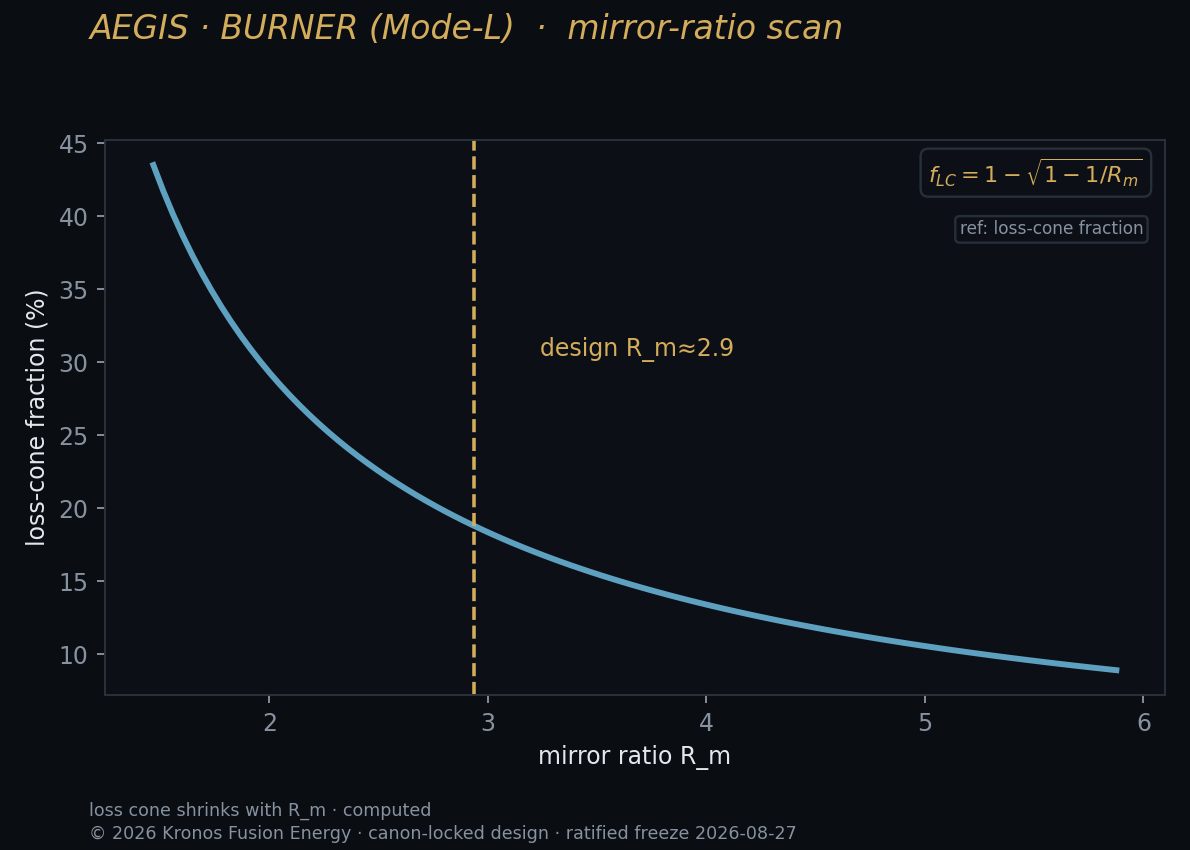
The electrostatic potential profile confines the burner's central cell; L1 regulates the ambipolar potential through plug conditions to hold axial confinement.
Confinement by potential
In a tandem mirror, the central-cell ions are confined axially by an electrostatic potential built by the end plugs — the ambipolar potential. Its height, set by plug electron temperature and density, determines how well central-cell ions are held. Regulating this potential is the physics goal that plug density control serves.
What sets the potential
The ambipolar potential arises from the requirement that ion and electron losses balance (ambipolarity). Roughly, the confining potential scales with the plug electron temperature and the density contrast between plug and central cell, following a Boltzmann-like relation eφ ~ T_e ln(n_plug/n_cc). L1 therefore actuates on plug heating and fueling to shape T_e and the density ratio, and thus φ.
The regulation problem
- Estimate the potential profile from plug/central-cell diagnostics.
- Actuate plug beam power and fueling to set T_e and density ratio.
- Reject losses that would let the barrier sag.
- Coordinate with DEC, which draws on the same escaping-ion flow.
The potential is not measured as directly as a coil current, so L1 relies on a model-based estimate from the diagnostics, refined by the L3 twin. The fast loop holds the estimate to setpoint; the twin audits it on the 50–100 ms shadow, flagging drift the fast loop should correct.
Why it is the burner's equilibrium problem
Where the breeder's central control problem is magnetic equilibrium and shape, the burner's is the ambipolar potential and plug conditions. Both are 'hold the confining configuration' problems; they simply use different physics. L1 provides the same deterministic-loop discipline to each. The potential also gates direct energy conversion, since the energy of escaping ions depends on the potential they fall through.