Learn › Comparisons & deep-dives
Deep dive · Falsifiability
The falsifiable claims.
A credible design says what would prove it wrong. Kronos states its case as falsifiable claims — each a specific prediction with a clear failure condition.
- Form
- Specific predictions with failure conditions
- Breeder claims
- Confinement, exhaust, triangularity
- Burner claims
- Plug density, closure, direct conversion
- Purpose
- Make the design refutable, not just plausible
Each claim below is meant to be tested and, if it fails, to count against Kronos.
- Breeder confinement. Nonlinear gyrokinetics will support a confinement multiplier near H₉₈ = 2.28. Fails if turbulence caps confinement below that.
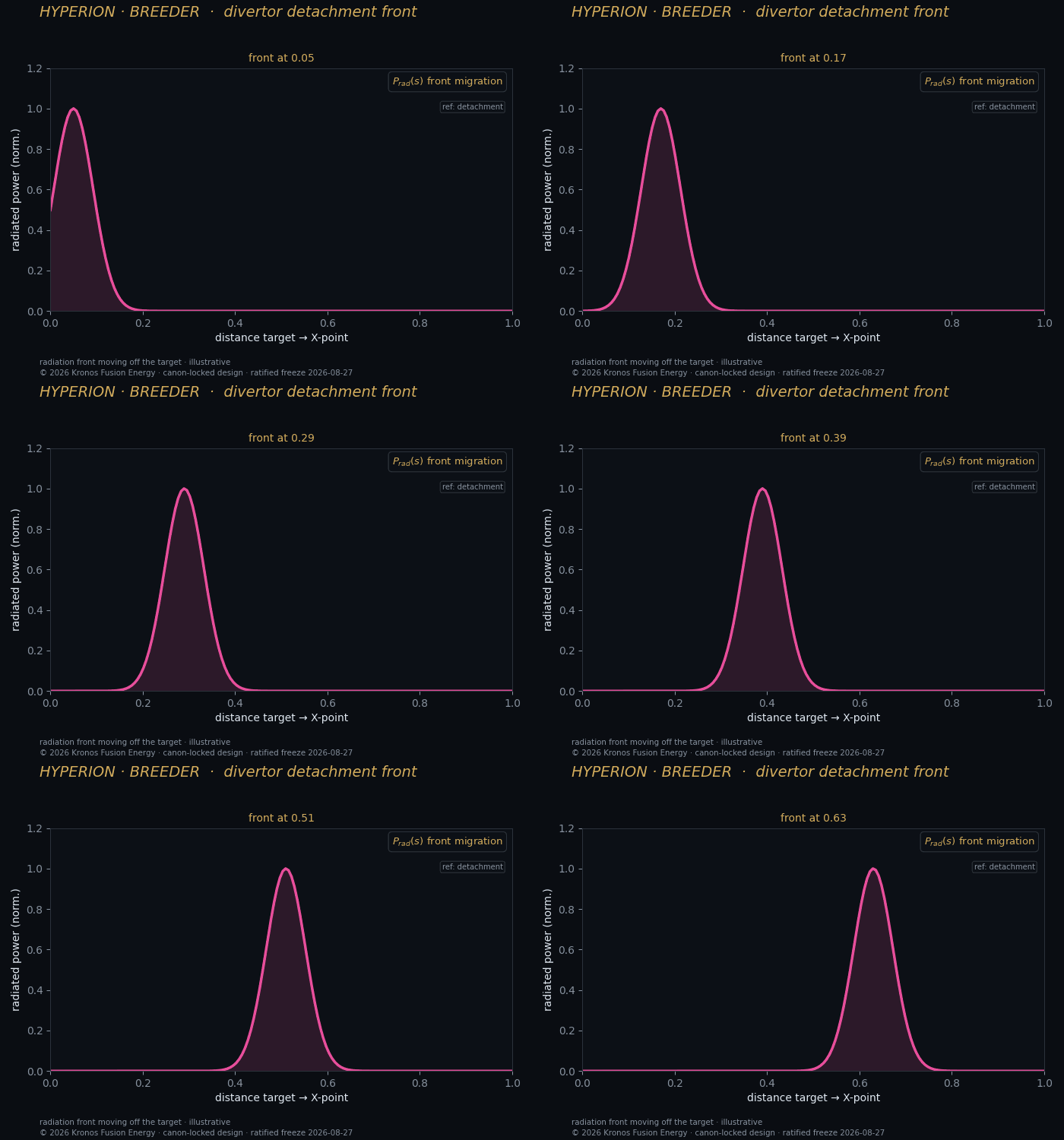
- Breeder exhaust. The divertor can meet the ≈90% radiated-fraction requirement. Fails if detachment physics cannot reach it at the design's heat flux.
- Breeder breeding. A tritium breeding ratio up to ~1.8 is achievable. Fails if realistic blanket coverage falls short.
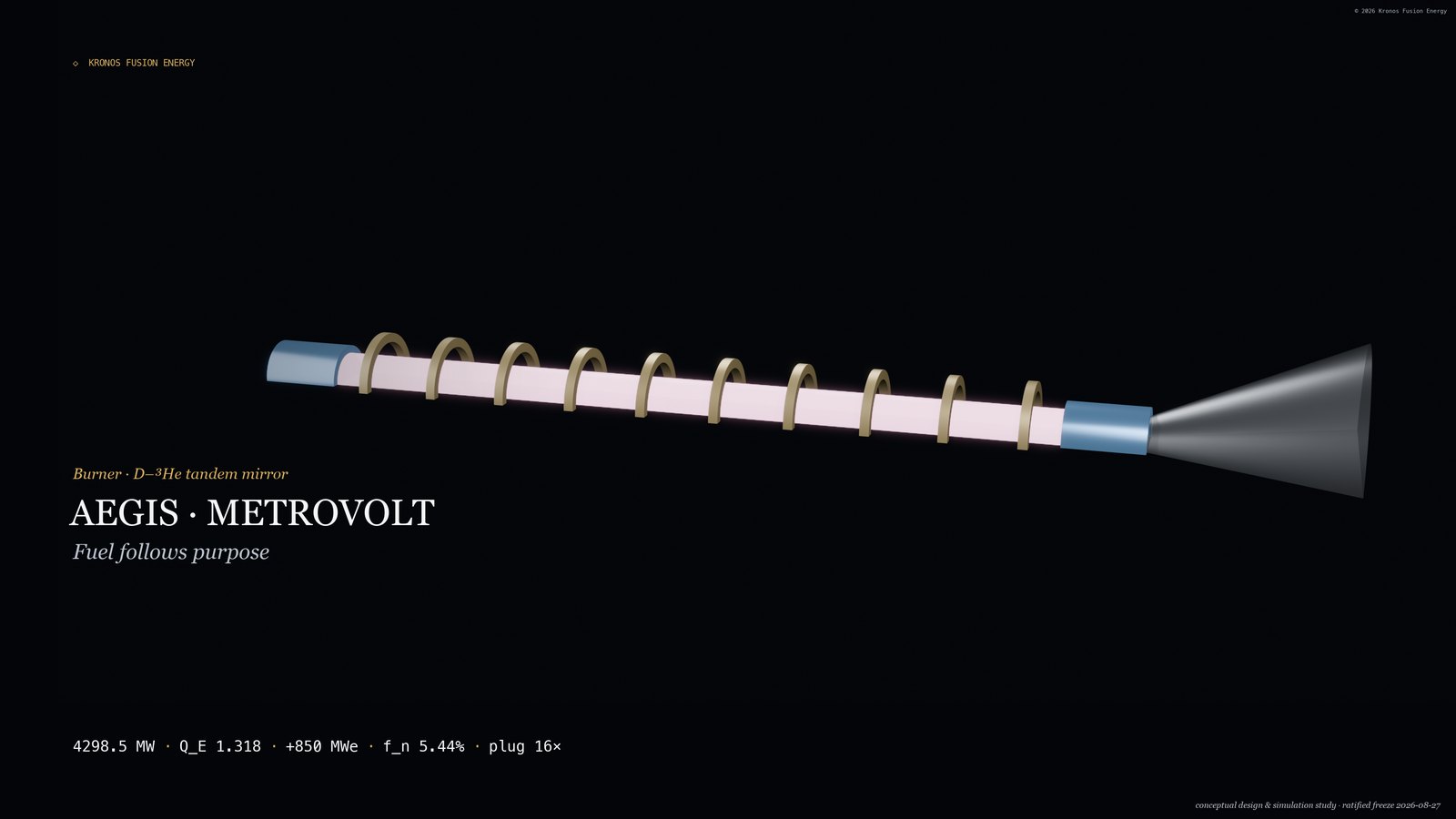
- Burner closure. D–³He closes (Q_E > 1) at the Mode M point. Fails if the power balance does not reproduce — it does, from the deposit.
- Burner plug density. An end-plug density ~16× the central cell is reachable. Fails if plug physics caps the ratio far below 16 — the biggest bet.
- Direct conversion. Charged-particle collectors reach their assumed efficiency. Fails if the electron channel and thermal barrier erode it.
- Fuel logic. Breeder decay helium-3 can seed a burner demonstrator. Fails if inventory or handling falls short.
Some of these are demonstrated, some reproducible, and some — notably plug density — are open requirements. All are stated so they can be checked.
Where the risk concentratesClaim 5 (plug density) is the load-bearing bet; claims 1–2 are the breeder's. See the open questions for the evidence class of each.