The plug-density requirement.
This is the honest caveat that travels with every burner number: the closing point is a requirement, not a demonstration. It rests on an end-plug density no mirror has yet reached.
- Required ratio
- n_p / n_c ≈ 16
- Required plug density
- 4.16×10²¹ m⁻³
- Versus experiment
- ≈ 347× GDT-measured · 26× best published mirror design
- If not met (n_p/n_c = 10)
- Does not close — Q_E 0.63, net −160 MWe
- Class
- Requirement, not verdict
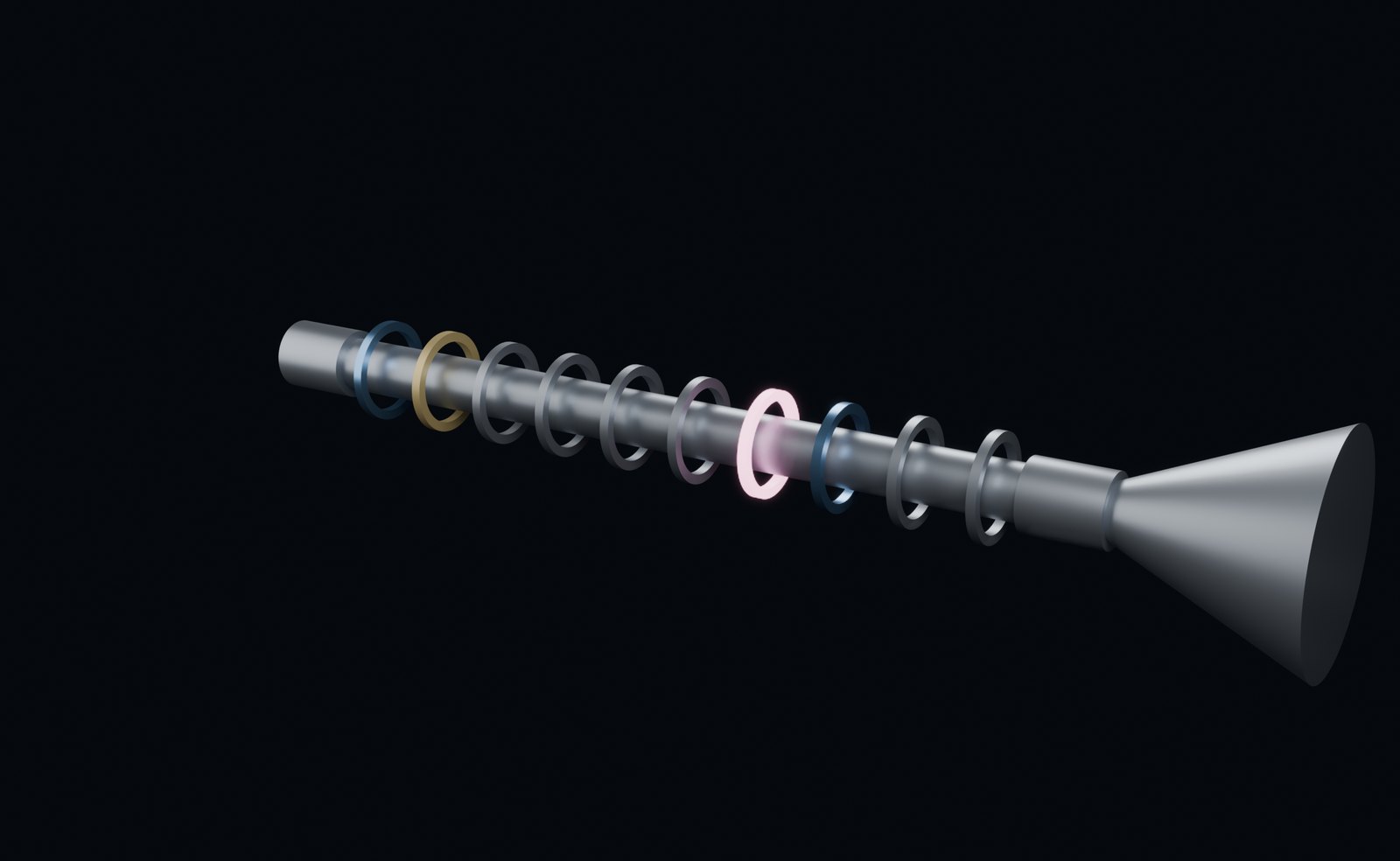
A tandem mirror confines its central-cell ions with an electrostatic potential raised by dense plasma in the end plugs. The deeper that potential, the better the confinement — and the potential grows with how much denser the plug is than the central cell. The Mode M closing point requires that ratio to be about 16, which means a plug density of 4.16×10²¹ m⁻³.
Kronos states, without softening it, how far that is from experiment: roughly 347× the density measured on GDT (the reference gas-dynamic-trap experiment) and about 26× the best published tandem-mirror design. It is recorded as "the largest open item" for the burner.
The consequence is spelled out too. At a more conservative ratio of 10, the machine does not close: Q_E falls to 0.63 and net power goes to −160 MWe. So the difference between a working burner and a net-negative one is precisely this plug performance — which is why Kronos labels the entire closing result requirement-class rather than demonstrated.
Naming a hard requirement is not the same as claiming it is solved. This page exists so that no one reads the burner's Q_E 1.31 without also reading what it depends on.