Learn › Questions people ask
Question
Why do neutrons matter in fusion?
Neutrons carry energy but no charge — they damage materials, activate structures, and can't be converted directly. Minimizing them is the core Kronos advantage.
Neutrons are the hidden cost driver of fusion, and minimizing them is the decision from which most Kronos advantages flow. See does D–³He produce neutrons?, neutron activation, and what does 'low-neutron' mean?
Questions & answers
Why are neutrons such a big deal in fusion?
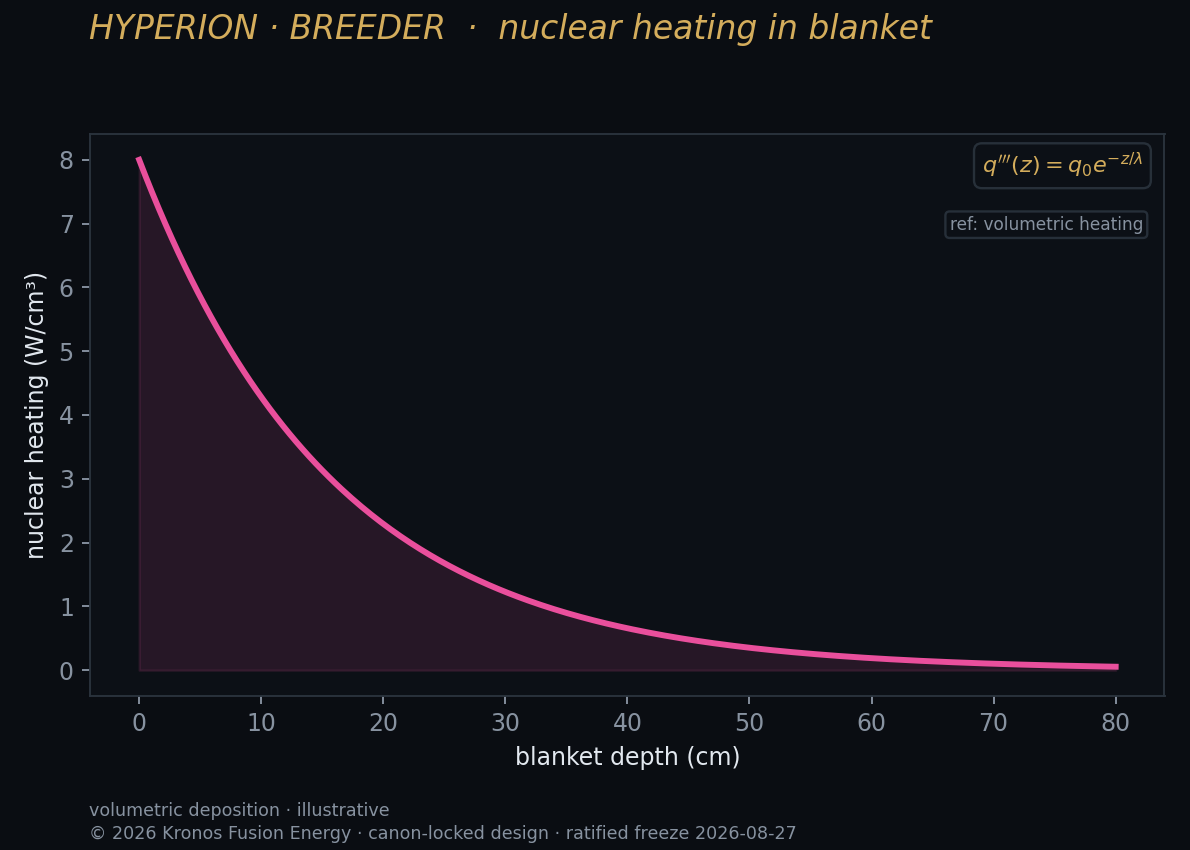
Because neutrons carry no electric charge, they fly straight through magnetic fields and slam into the reactor structure. There they do three unwelcome things: damage materials (embrittlement, swelling), make structures mildly radioactive (activation), and — being uncharged — cannot be captured by direct energy conversion, so their energy can only become heat.
So fewer neutrons is better?
Much better. Fewer neutrons means less material damage, thinner shielding, less activated waste, longer component life, and more of the energy emerging as charged particles that can be converted efficiently. This is the whole rationale for a low-neutron fuel.
How does Kronos reduce neutrons?
By running deuterium–helium-3 rather than deuterium–tritium. Its neutron fraction is 7.70% at the operating baseline (≈5.44% at the frozen design point) — roughly an order of magnitude below D–T — so it is 'low-neutron,' though not neutron-free.