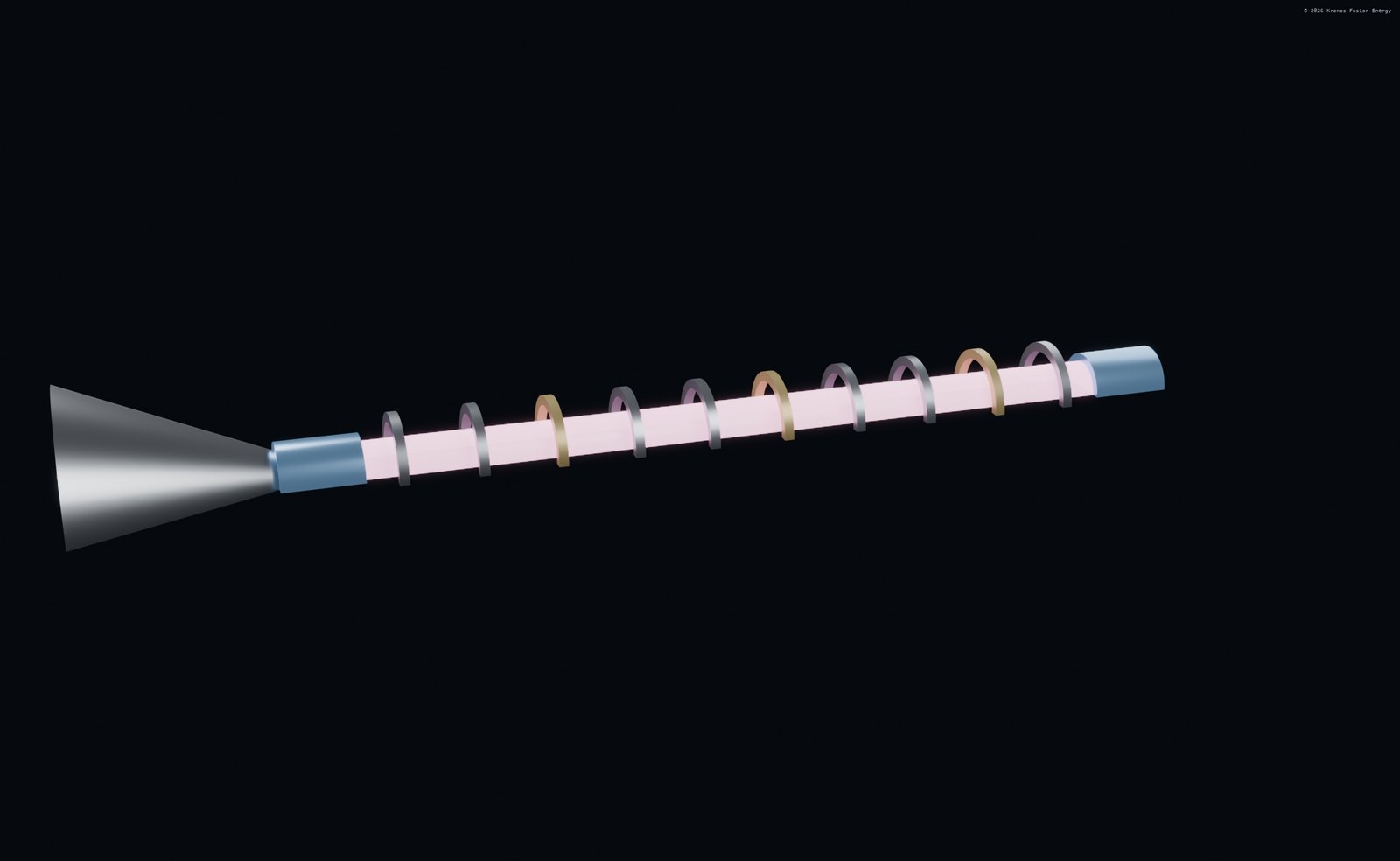
Helium-3 is scarce on Earth. Kronos runs a staged, catalyzed D–³He cycle that breeds much of its own ³He, so the plant is not hostage to thin external supply.
Helium-3 is the fuel question skeptics reach for first, and rightly so: if a design depends on a material
that barely exists, it is not a plan. Kronos answers this at the level of the fuel cycle, not the fuel
market.
The Kronos approach is a staged, catalyzed D–³He cycle. The plasma burns deuterium against itself and
against helium-3; the D–D reactions breed fresh helium-3 (directly, and via tritium that decays to ³He), so a
large share of the plant's ³He is made in situ. That converts "where do you buy scarce ³He?" into a
mass-balance engineering problem the design series addresses head-on, and it is why the fuel roadmap is
described as staged — commissioning, D-rich operation, and the ³He-rich optimum in sequence.
Questions & answers
Isn't helium-3 extremely rare?
Yes. Terrestrial helium-3 is scarce — it comes mainly from tritium decay in weapons stockpiles, and the open market is thin. A fusion economy cannot be built on buying external ³He at today's volumes.
So how does a Kronos plant get its fuel?
Kronos runs a staged, catalyzed D–³He cycle. Deuterium–deuterium reactions inside the plasma breed helium-3 (and tritium that decays to helium-3), so the plant supplies much of its own ³He rather than importing it. The fuel staging and ³He mass balance are worked out explicitly in the design series.
What about mining helium-3 on the Moon?
Lunar regolith helium-3 is a genuine long-horizon resource, and it is part of the broader story — but Kronos treats it as a complement, not a requirement. The commercial design does not depend on lunar supply.
Watch
Honest gapThe prompt ³He breeding channel and the ³He mass balance are worked in the design series; the external ³He market remains thin, which is exactly why the in-situ breeding pathway — not procurement — carries the fuel argument.