Learn › Questions people ask
Question
What is nuclear fusion?
Nuclear fusion is the joining of light atomic nuclei to release energy — the process that powers the sun, and the basis of the Kronos generators.
Nuclear fusion is the reaction that powers every star: light nuclei, forced close enough to overcome their electrical repulsion, merge and release energy. Recreating it on Earth for power means heating a fuel to over a hundred million degrees and holding it — the challenge the whole field, and Kronos, is built around.
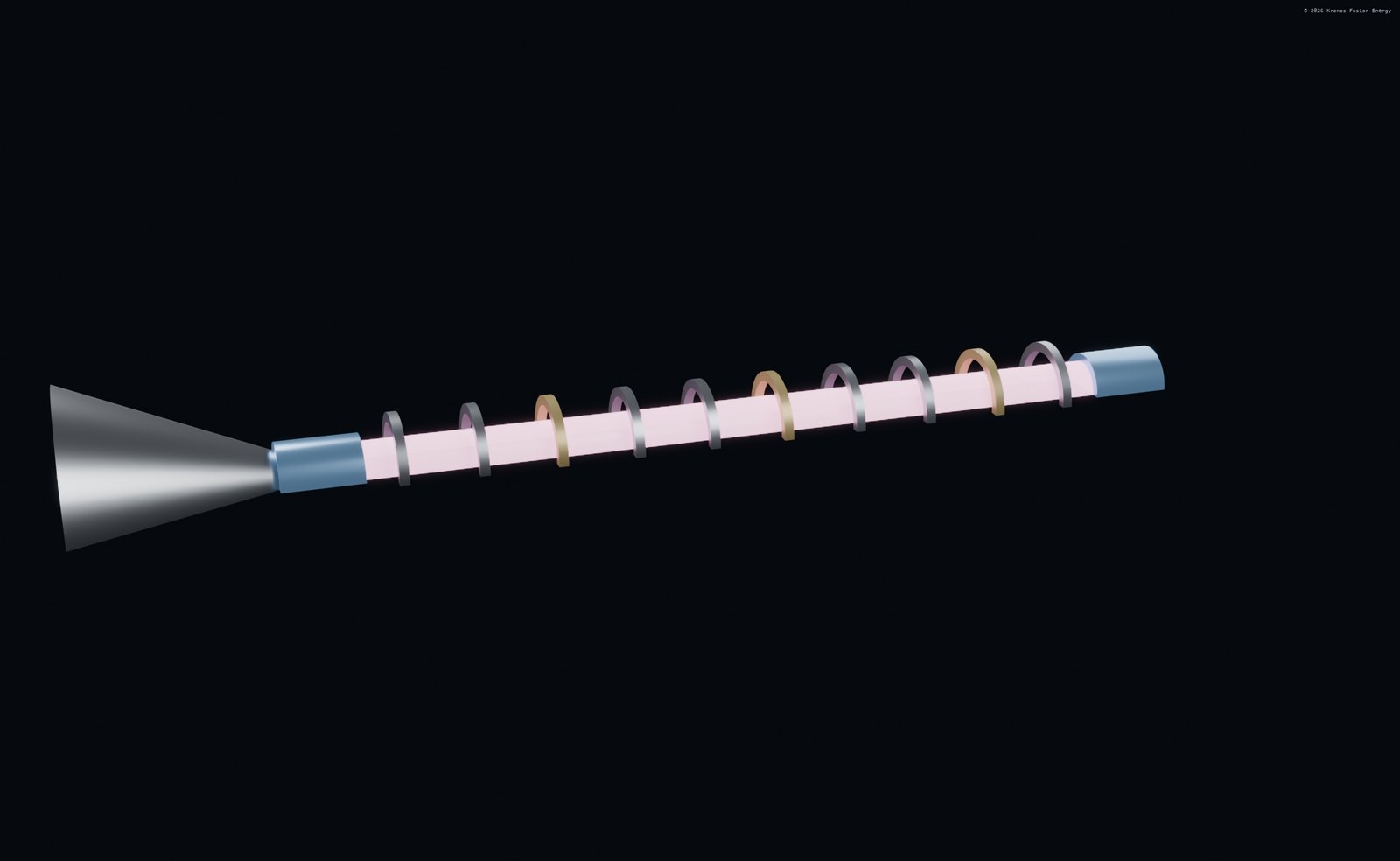
Kronos MetroVolt fuses deuterium and helium-3, a low-neutron combination, and captures the energy with direct energy conversion.
Questions & answers
What is nuclear fusion?
Fusion is the process of forcing two light atomic nuclei together so they merge into a heavier one, releasing a large amount of energy. It is what powers the sun and stars. On Earth, a fusion power plant recreates the conditions for fusion — extreme temperature and confinement — to generate electricity from a tiny amount of fuel.
How is that different from what a nuclear plant does today?
Today's nuclear plants use fission — splitting heavy uranium nuclei. Fusion does the opposite, joining light nuclei like deuterium and helium-3. Fusion has no chain reaction, cannot melt down, and produces no long-lived spent fuel.
How much energy does fusion release?
An enormous amount per unit of fuel — millions of times more than burning fossil fuels, gram for gram. That extreme energy density is why a compact machine like Kronos MetroVolt can target gigawatt-class fusion power from very little fuel.