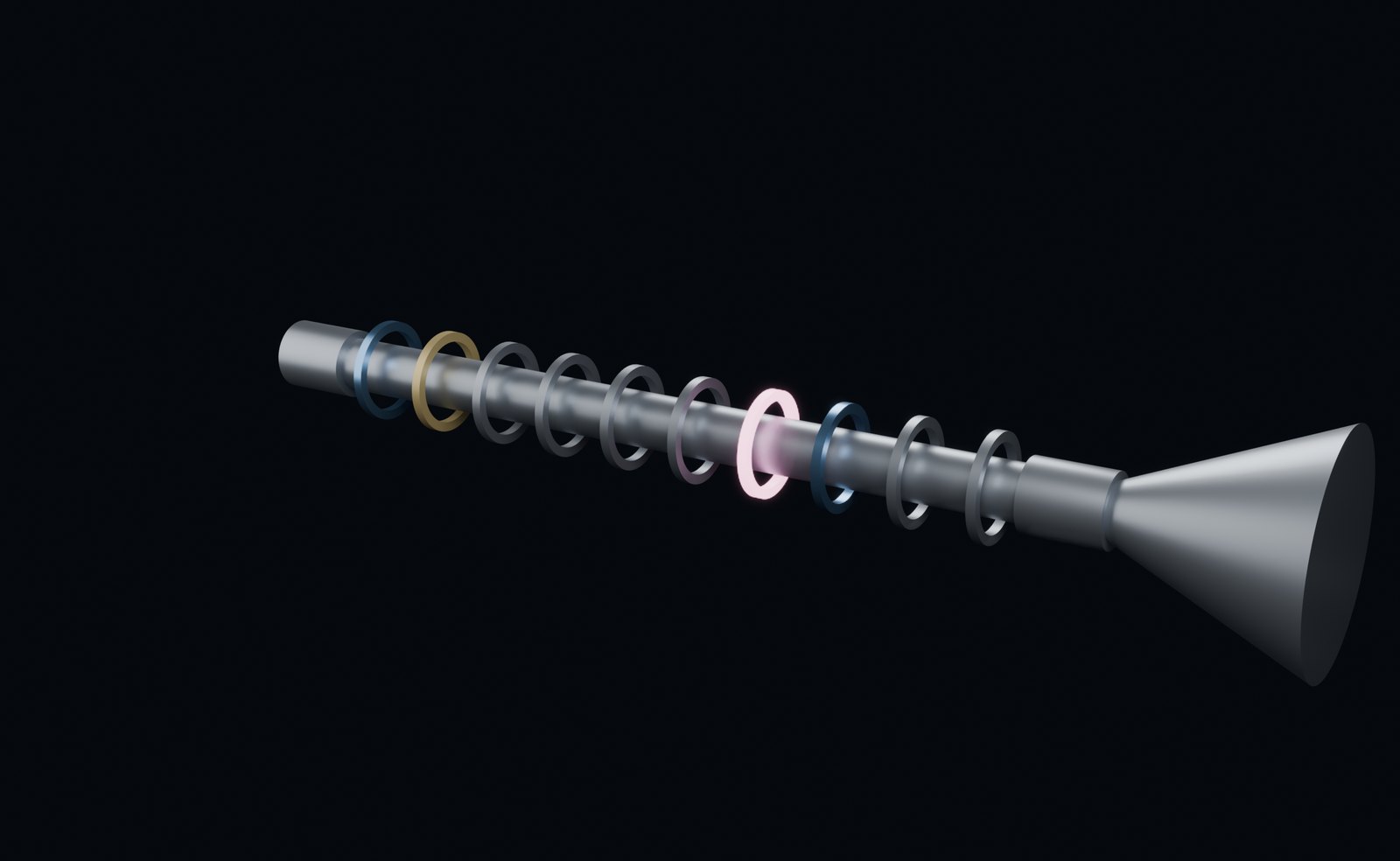
A spherical tokamak squeezes the donut into a cored apple — a low aspect ratio that improves stability and efficiency. Kronos MetroVolt runs at aspect ratio 2.0.
A tokamak confines fusion plasma in a magnetic donut. Its aspect ratio — major radius divided
by minor radius — sets the shape. Conventional tokamaks are thin donuts with aspect ratio 3–4. A
spherical tokamak pushes the aspect ratio down toward 1.5–2, squeezing the hole in the middle until the
plasma looks more like a cored apple.
Kronos MetroVolt is a spherical tokamak at aspect ratio A = 2.0 (major radius R₀ = 1.2 m, minor
radius a = 2.875 m, elongation κ = 2.56). The low aspect ratio raises the pressure the plasma can hold for a
given field and improves stability — a natural fit with the design's
negative triangularity and
high-field REBCO magnets.
Questions & answers
What makes a tokamak 'spherical'?
Aspect ratio — the ratio of the major radius (torus size) to the minor radius (plasma cross-section). A conventional tokamak is a thin donut (aspect ratio 3–4). A spherical tokamak squeezes it toward a cored apple, with aspect ratio near 1.5–2. Kronos MetroVolt runs at aspect ratio A = 2.0 (R₀ = 1.2 m, a = 2.875 m).
Why choose the spherical shape?
Low aspect ratio improves plasma stability and lets the plasma hold more pressure for a given magnetic field, which is efficient. It pairs well with negative triangularity and high-field HTS magnets.
Is MetroVolt small, then?
It is compact for its output, but not tiny: a 1.2 m major radius machine designed for hundreds of megawatts to gigawatt-class fusion power. The spherical shape is about efficiency and stability, not merely size.