
Deep Dive: The Vertical Stability Problem
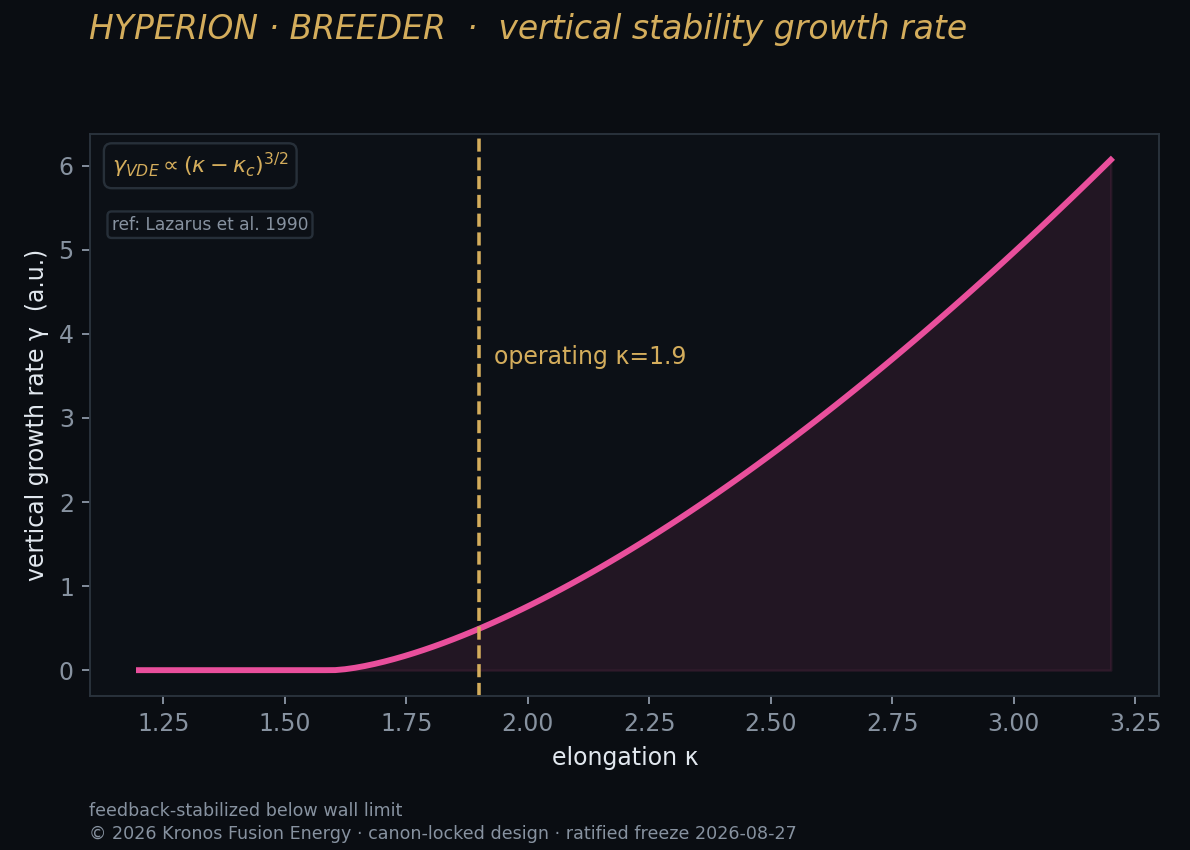
A strongly elongated plasma is vertically unstable and must be actively held. Kronos runs κ = 2.56 with a corrected control margin of 2.02.
- Elongation
- κ = 2.56 (strong shaping)
- Instability
- Vertical drift → VDE
- Control margin
- 2.02 at the floor (S69)
- Means
- Passive plates + active feedback
Elongating the plasma vertically (κ = 2.56) lets Kronos MetroVolt carry more current and pressure for its size — a real performance gain. But it comes with a cost: a tall plasma is vertically unstable, prone to drifting up or down into the wall in a vertical displacement event (VDE).
Managing this is a first-order design problem. The plasma is held by a combination of passive conducting plates (which slow any drift) and fast active feedback through the poloidal-field coils. The deposited analyses (S24, rerun at final size as S69) give a corrected vertical-control margin of 2.02 at the floor — comfortably above the stability threshold of 1.
Vertical control matters beyond performance: a VDE is one pathway into a full disruption, so the margin is tracked carefully and is part of the plant's safety case.