The fuel cycle, in depth.
The Kronos fuel cycle is a hand-off between two machines. This is how the breeder's output becomes the burner's fuel — and where the honest limits are.
- Breeder fuel
- Deuterium + tritium (bred on site)
- Breeder TBR
- Up to 1.8 (a design lever)
- Decay product
- Helium-3 (12.3-yr tritium half-life)
- Burner fuel
- Deuterium + helium-3
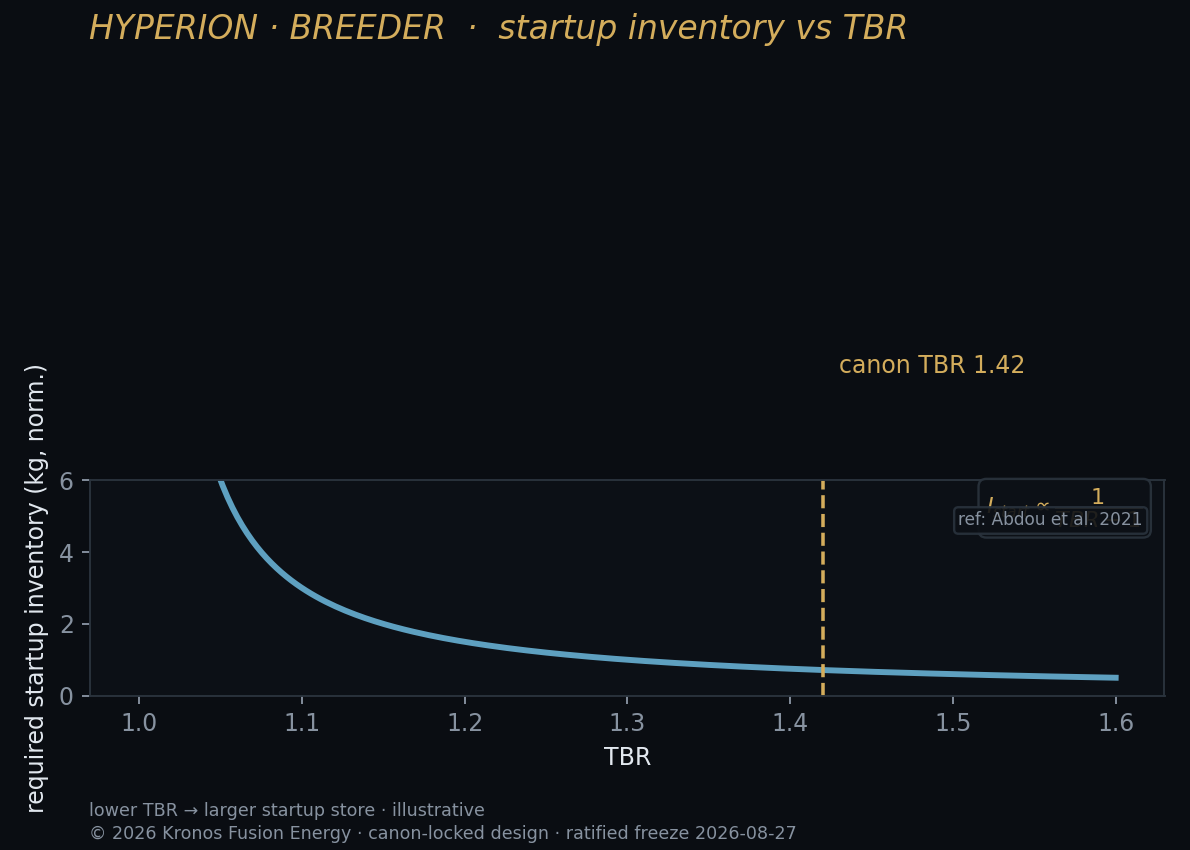
The cycle begins in the breeder. HYPERION burns D–T; its neutrons are captured to breed tritium at a ratio treated as a design lever (1.1 / 1.5 / 1.8 in the scan), yielding about 4 kg/yr at the design point. Tritium is unstable — it decays with a 12.3-year half-life into helium-3, so an aging tritium inventory becomes a helium-3 supply of roughly 1.97 kg/yr.
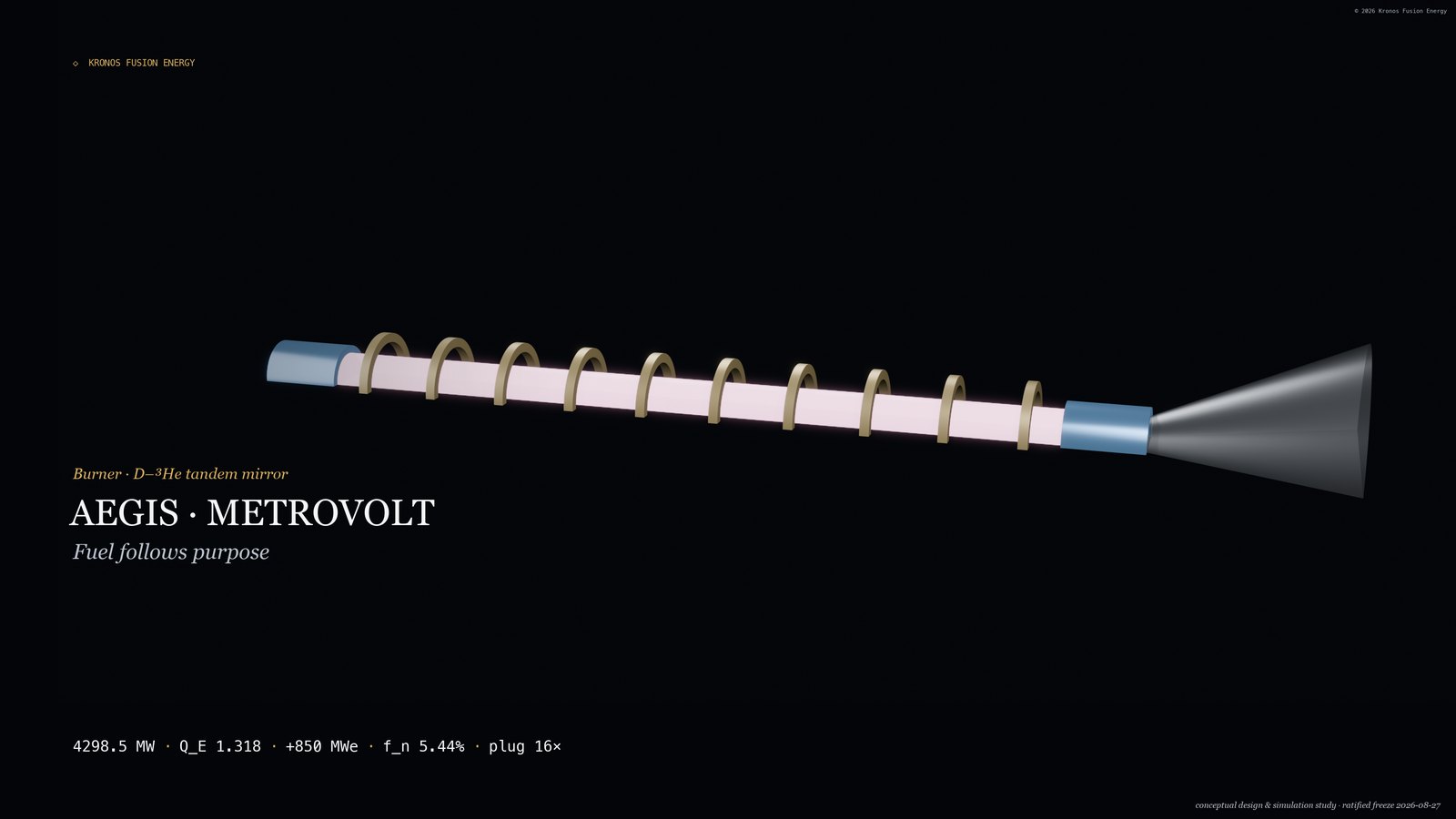
That helium-3 is the seed fuel for the burner, which runs D–³He at its Mode M closing point. Decay helium-3 is enough to run a ~10 MWe burner demonstrator — but not a commercial fleet, which is why the fleet is honestly gated on an external (lunar) helium-3 supply.
There is no single-reactor "staged" ladder here: the fuel cycle is a hand-off between two purpose-built machines.