Learn › Comparisons & deep-dives
Deep-dive
Deep Dive: The Multi-Modal DEC Train
Kronos layers four conversion modes — direct charged-particle, MHD, thermionic, and photonic — to reach a blended, gate-adjudicated efficiency without betting on one method.
- CPDC (S16)
- Charged-particle direct converter
- MHD (S17)
- Plasma-exhaust MHD generator
- Thermionic (S18)
- Solid-state heat-to-electricity
- Photonic (S19)
- Radiation capture
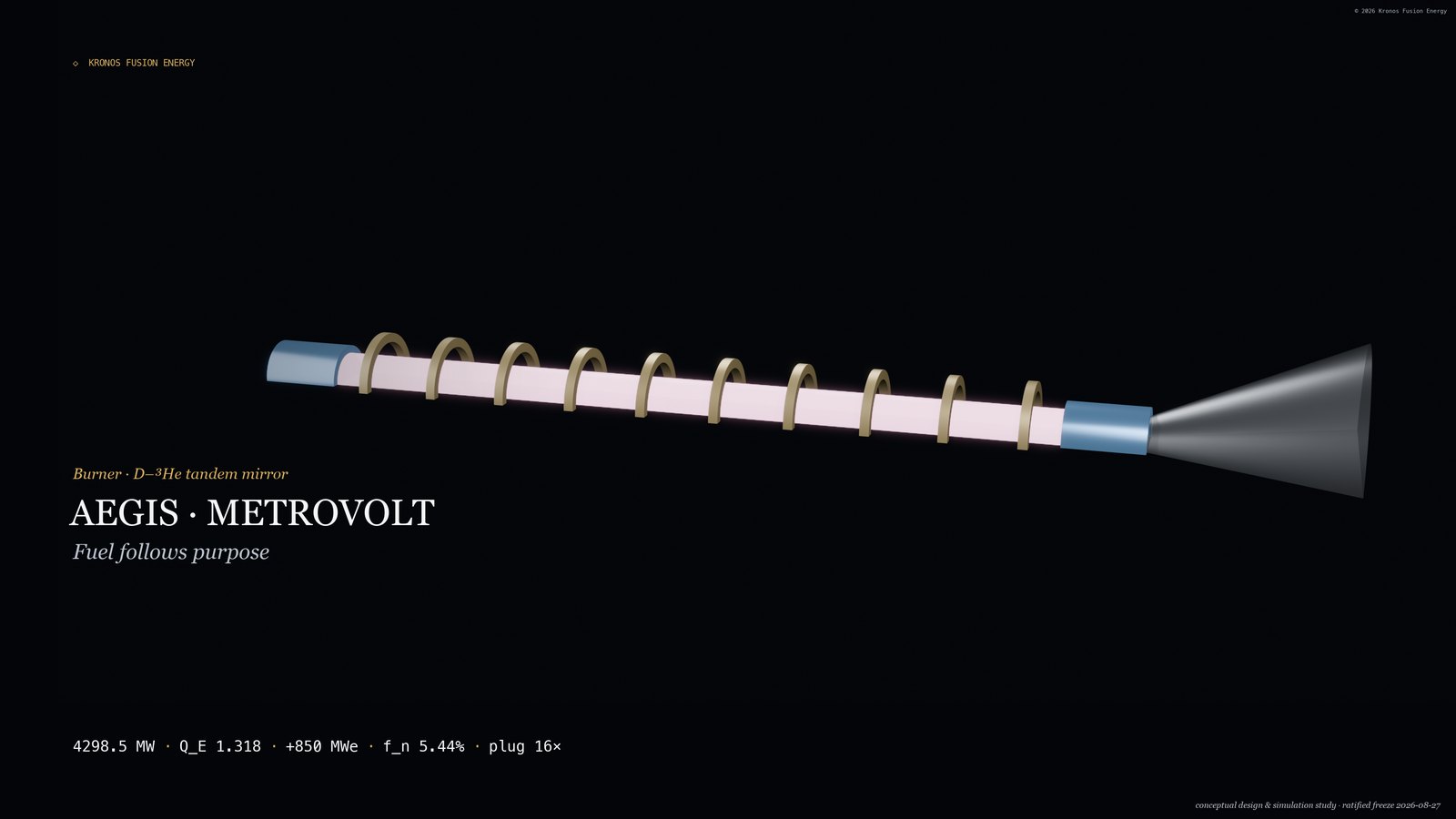
Rather than rely on a single conversion method, Kronos MetroVolt uses a multi-modal direct-energy-conversion train — a sequence of complementary stages, each catching a different slice of the fusion energy, deposited and analyzed individually.
- Charged-particle direct converter (S16) — decelerates protons and alphas against a collector to recover their energy directly.
- Plasma-exhaust MHD generator (S17) — extracts power from the flowing conducting exhaust, no moving parts.
- Thermionic conversion (S18) — a solid-state stage turning high-temperature heat into electricity.
- Photonic capture (S19) — recovers energy from the plasma's bremsstrahlung and synchrotron radiation.
Because the modes are complementary, the design quotes a blended, gate-adjudicated efficiency rather than betting everything on one method — and the overall optimum is ³He-rich (η ≈ 0.60), not the aneutronic endpoint (analysis S71). Layering modes is also what keeps each mode's assumptions individually checkable.
Honest gapA fraction of the exhaust (f_exh ≈ 0.18) is un-channeled in the baseline, and the DEC economics share the fast-ion channeling demonstration (P6) with the hot-ion posture — both gated.