Deep Dive: The Cryogenic System
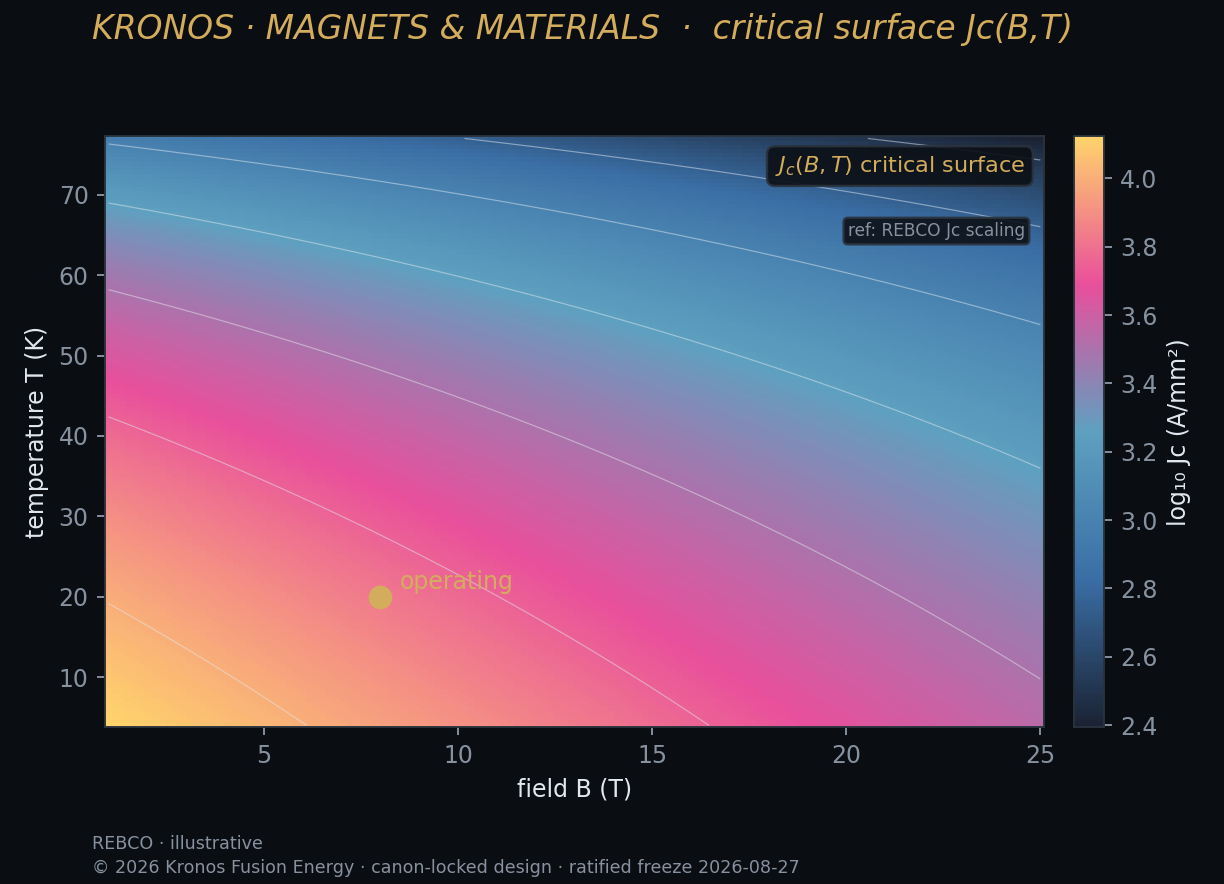
The HTS magnets must be kept cold — but at ~20 K, not the ~4 K of low-temperature magnets. That higher operating temperature meaningfully eases the cryoplant.
- Job
- Keep the HTS magnets superconducting
- Kronos temperature
- ~20 K
- LTS comparison
- ~4 K (liquid helium)
- Benefit
- Easier, more efficient cooling
Superconducting magnets only work cold, so a fusion plant needs a substantial cryogenic plant to hold the coils at temperature against heat leaking in from a 100-million-degree plasma nearby. The cryoplant is part of the plant's recirculating load, so its efficiency directly affects engineering gain.
Here the Kronos choice of HTS (REBCO) pays a second dividend. Conventional low-temperature magnets must sit near 4 K, requiring liquid helium and large refrigeration power. HTS operates near 20 K — a five-fold higher temperature that makes cooling substantially easier, more efficient, and more robust to transient heat loads.
That reduced cooling burden recovers recirculating power that would otherwise cut into net output, and it improves the plant's resilience — one more way the HTS magnet choice ripples through the whole design. See the magnet & shield system.