Runaway electrons.
During a tokamak disruption, some electrons can be accelerated to damaging energies — a 'runaway' beam. It's a hazard the breeder must manage, and one the burner's geometry sidesteps.
- What they are
- Electrons accelerated to high energy in a disruption
- Risk
- Localized wall damage
- Breeder
- Mitigated as part of disruption handling
- Burner
- No current-driven runaway channel
When a tokamak disrupts, the collapsing current can induce strong electric fields that accelerate a small population of electrons to very high energy. This runaway electron beam can drill localized damage into plasma-facing components, so mitigation (massive gas or pellet injection) is a required system on any large tokamak — including the Kronos breeder.
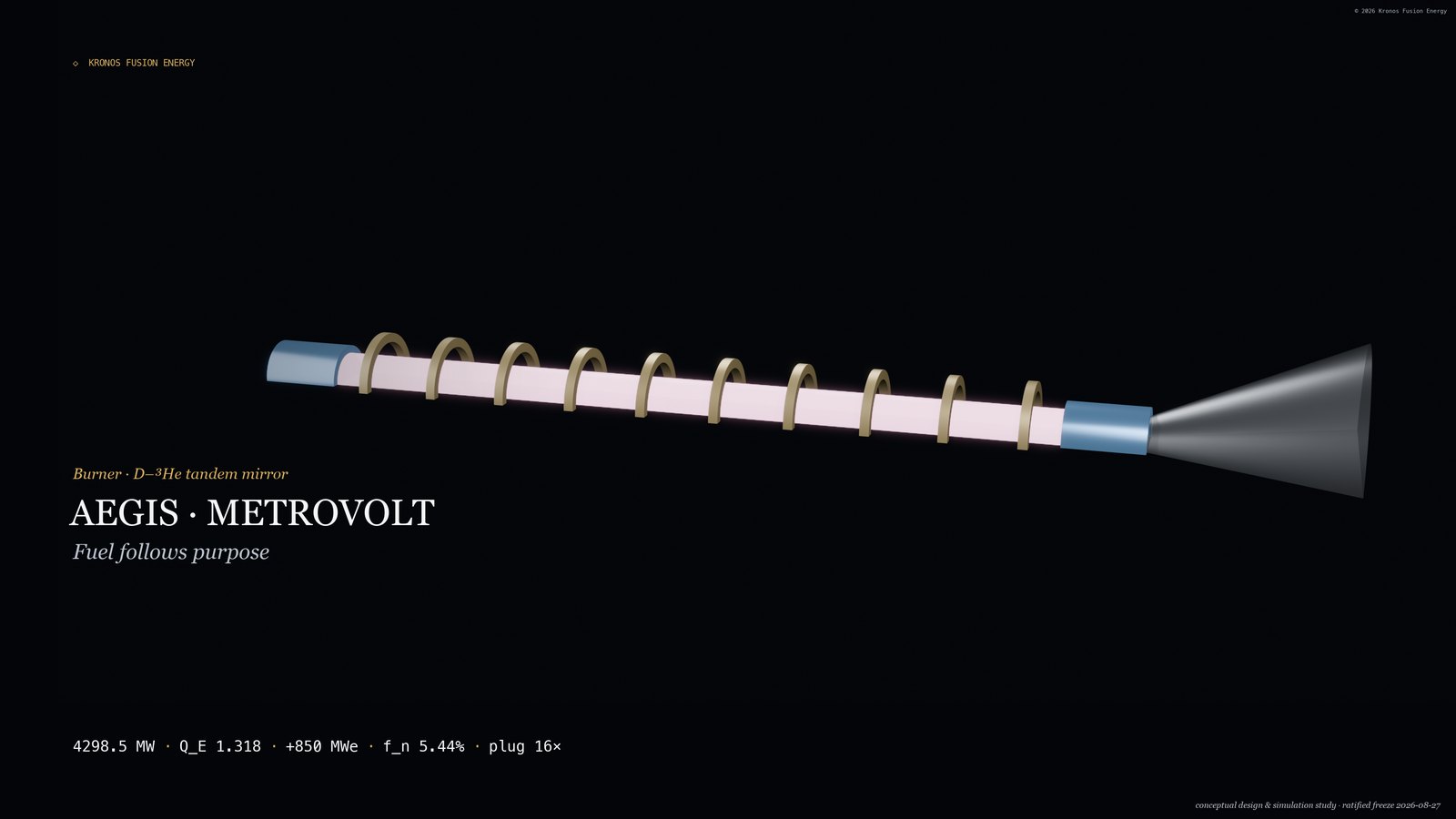
The burner does not have the current-quench mechanism that drives runaways in a tokamak, because it has no plasma current to quench. That is another way the open-field-line architecture removes a tokamak failure mode rather than mitigating it.