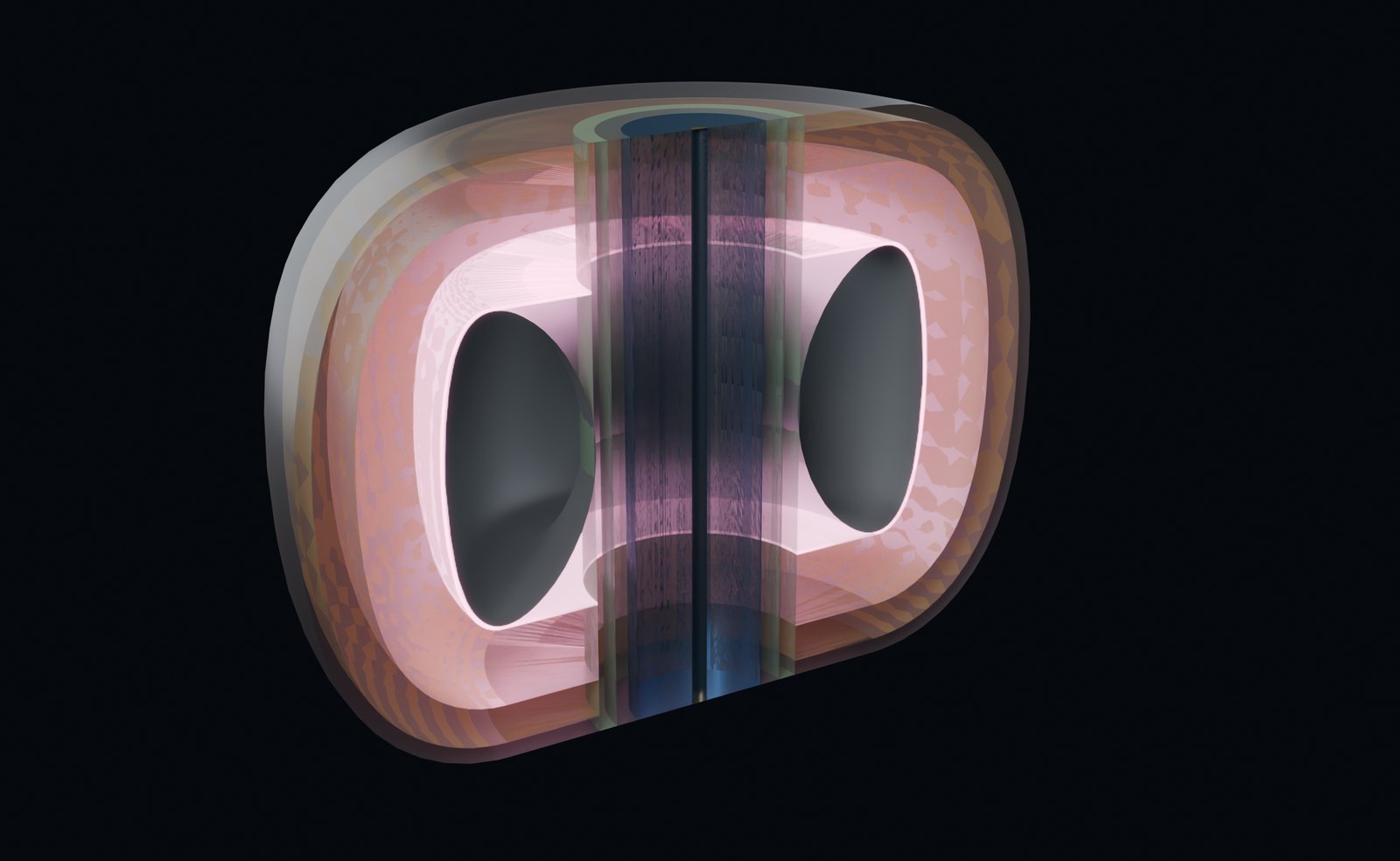
Hafnium Carbide First Wall
Kronos uses a laser-fused hafnium carbide first wall — a refractory, highly reflective surface that recycles synchrotron radiation.
- Material
- Laser-fused hafnium carbide (HfC)
- Property
- Ultra-high melting point; highly reflective
- Reflectivity
- R_wall ≥ 0.90 (prediction P5)
- Role
- Endures heat flux; recycles synchrotron radiation
Kronos MetroVolt's first wall is made of laser-fused hafnium carbide (HfC), one of the most refractory ceramics known, with a melting point above 3,900 °C. Two properties earn it the job: it withstands the sustained heat and particle flux at the plasma boundary, and it is highly reflective to microwave radiation.
That reflectivity matters because a high-field machine loses power to synchrotron radiation. A wall reflectivity of R_wall ≥ 0.90 recycles most of that power back into the plasma — which is why the 158 MW synchrotron budget assumes it. Maintaining R_wall ≥ 0.90 after ion fluence and at temperature is one of the pre-registered predictions (P5), measured at the G1 gate.