Fusion Neutronics
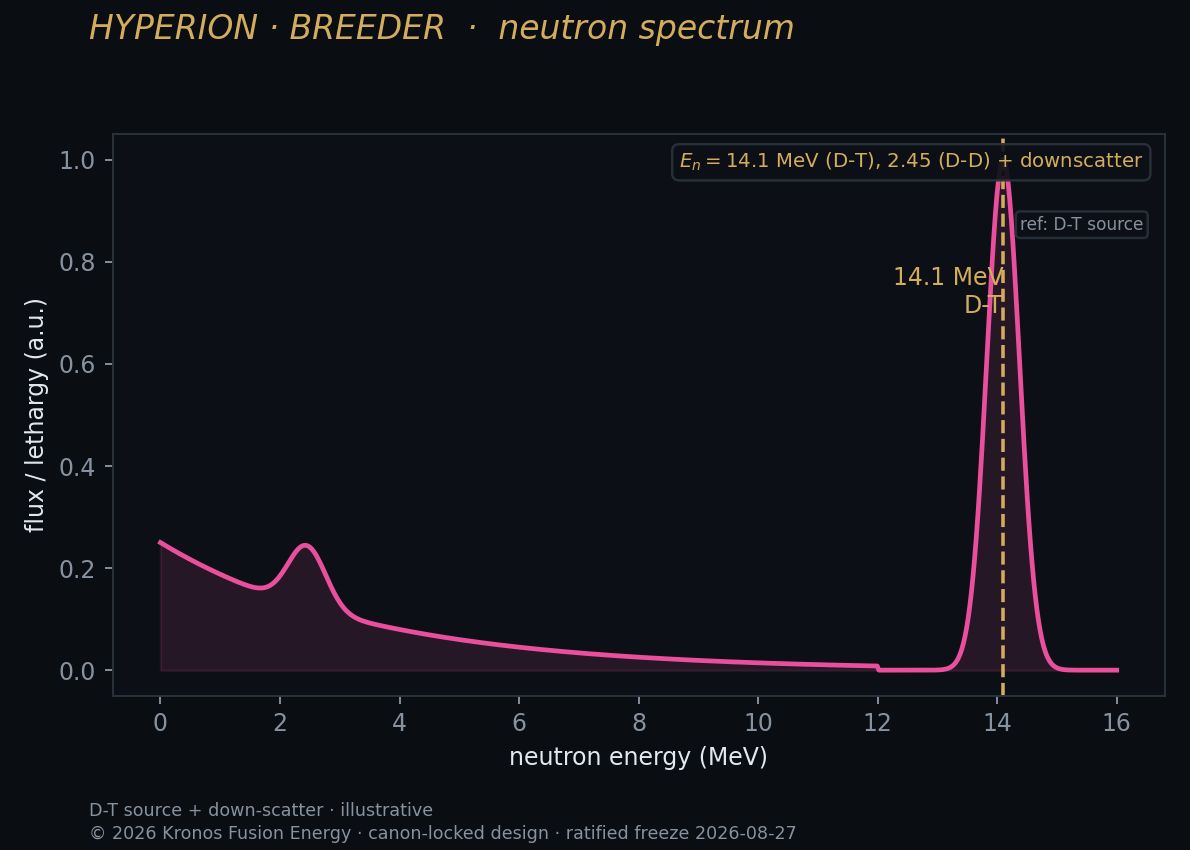
Neutronics is the study of how fusion neutrons travel, deposit energy, and activate materials. For a low-neutron plant, the numbers are far gentler.
- What
- Transport of neutrons through reactor materials
- Concerns
- Heating, damage (dpa), activation, shielding
- Kronos neutron fraction
- 7.70% operating, ≈5.44% at the frozen design point (low-neutron)
- High-fidelity check
- OpenMC (S63, planned)
Fusion neutronics is the discipline of tracking where a reactor's neutrons go: how they scatter and slow through the wall and shield, how much heat and radiation damage (measured in displacements per atom, dpa) they deposit, and how much they activate the structure. It sets the shield thickness, the component lifetimes, and the waste profile.
For Kronos MetroVolt the neutronics is unusually gentle by fusion standards, because the low-neutron D–³He fuel produces a neutron fraction of 7.70% at the operating baseline (≈5.44% at the frozen design point) — roughly an order of magnitude below D–T. The design carries an explicit neutron-fluence budget for the shielded center stack, and a high-fidelity OpenMC neutronics calculation (S63) is planned to fix the true shield and lifetime numbers.